

The invite arrives and the calculation starts instantly. How many people will be there. Whether you’ll know anyone. How long you have to stay before leaving feels acceptable. Whether there’s an easy exit if the room gets too loud or the conversation gets too close.
Social anxiety isn’t shyness. It’s a pattern of anticipatory dread, self-monitoring during interactions, and post-event rumination that turns ordinary social situations into endurance tests. It affects an estimated 7% of the U.S. adult population, making it one of the most common anxiety disorders, and the coping strategies most people default to (alcohol, avoidance, or white-knuckling through it) either create new problems or reinforce the cycle.
Kratom gummies are entering this conversation as a third option. Not a cure. Not a replacement for therapy. But a plant-based tool that some users report helps quiet the internal noise enough to show up, engage, and actually participate in the social moments that anxiety tries to steal.
Here’s what the science supports, what it doesn’t, and how to approach this honestly.
Why Social Situations Feel Like Threat Situations
Social anxiety isn’t a personality flaw. It’s a neurochemical pattern.

When your brain perceives a social situation as threatening (judgment, embarrassment, rejection), it activates the hypothalamic-pituitary-adrenal (HPA) axis, the same stress response system that fires during physical danger. Cortisol and adrenaline flood your system. Your heart rate spikes. Your prefrontal cortex, the part responsible for clear thinking and verbal fluency, gets partially hijacked by the amygdala’s threat response.
The result: you feel foggy when you want to be articulate, self-conscious when you want to be present, and exhausted by interactions that other people seem to navigate without effort. The experience isn’t “nerves.” It’s your stress response system misfiring in a context where it isn’t needed.
Three neurotransmitter systems play central roles in this pattern. Serotonin regulates mood stability and emotional resilience. Low serotonergic activity is associated with increased anxiety sensitivity. Dopamine drives reward perception and social motivation. Reduced dopaminergic activity in social contexts makes interactions feel effortful rather than rewarding. And the adrenergic system controls the fight-or-flight arousal that produces the physical symptoms (racing heart, sweating, trembling) that make anxiety visible.
Understanding these pathways matters because it explains why kratom’s mechanism is relevant to social anxiety in a way that’s qualitatively different from alcohol or sedatives.
How Kratom Interacts With Social Anxiety Pathways

Kratom’s primary alkaloid, mitragynine, doesn’t work through a single mechanism. It interacts with multiple receptor systems simultaneously, and at low to moderate doses, those interactions align with the three pathways that social anxiety disrupts.
Serotonergic modulation. Research published in Frontiers in Neuroscience (2026) confirmed that mitragynine produces anxiolytic effects by modulating serotonin, noradrenaline, and dopamine levels in brain regions involved in mood and anxiety regulation. A separate study from Behavioral Neuroscience Insights (2025) described kratom’s combination of mild opioid receptor activity and serotonergic modulation as “a blend rarely found in nature.” For social anxiety specifically, serotonin modulation helps stabilize the emotional overreactivity that makes social situations feel dangerous.
Dopaminergic activation. Mitragynine interacts with D2 dopamine receptors, which are directly involved in reward processing and social motivation. When dopamine activity increases in social contexts, interactions start feeling engaging rather than threatening. The internal narrative shifts from “I need to get through this” to “this is actually fine.” That shift isn’t intoxication. It’s your reward system functioning the way it does in people without social anxiety.
Adrenergic modulation. By interacting with alpha-2 adrenergic receptors, mitragynine can reduce the physical arousal symptoms (elevated heart rate, sweating, trembling) that make anxiety visible to others and that amplify the anxiety cycle through self-consciousness.
The combined effect, at low to moderate doses, is what users consistently describe as “grounded confidence.” Present. Warm. Comfortable in the room. Not high, not sedated, not artificially euphoric. Just operating without the threat response that normally dominates social settings.
The Social Event Dose: Practical Guidance
Dose determines everything. Too low and you won’t notice a difference. Too high and sedation replaces anxiety, which solves the nervousness problem but creates a new one: you’re too drowsy to engage.
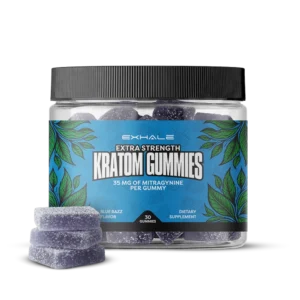
The social sweet spot is one kratom gummy taken 45 to 60 minutes before the social event. Exhale Wellness gummies use concentrated extract with lab-verified mitragynine content, so one gummy delivers the same precise dose every time. This consistency matters enormously for anxiety management because unpredictable effects create more anxiety, not less.
Timing strategy: If the event starts at 7 PM, take your gummy at 6:00 to 6:15 PM. By the time you arrive, the effects are settling in: mood elevated, physical tension eased, social warmth building. You walk in already feeling the shift rather than waiting for it to arrive while surrounded by people.
Empty vs. fed stomach: A completely empty stomach produces faster, sharper onset, which can feel slightly intense for anxiety-prone users. A light snack (crackers, fruit, a handful of nuts) 30 minutes before your gummy smooths the onset curve and produces a gentler arrival. For social anxiety specifically, the gentle version is usually better because sudden onset changes can trigger the very hypervigilance you’re trying to quiet.
Don’t redose at the event. One gummy is the dose. If you feel it isn’t enough after 60 minutes at the event, note that for next time. Don’t take a second gummy while you’re already in the social situation. Stacking doses in an anxiety-producing environment adds a variable you can’t control and undermines the predictability that makes this approach work.
Why This Isn’t Just “Kratom Instead of Drinking”
The sober curious movement has created space for people to attend social events without alcohol. But showing up sober-curious and showing up with social anxiety are different challenges.
Alcohol “works” for social anxiety through blunt CNS depression. It shuts down the prefrontal cortex’s self-monitoring function, which is why socially anxious people suddenly feel “free” after two drinks. But it also shuts down judgment, coordination, verbal precision, and memory formation. The anxiety is gone, but so is the version of yourself you’d actually want to bring to a social event.
Kratom at a social dose doesn’t suppress your self-awareness. It adjusts the emotional valence of that awareness from negative (threat, judgment, scrutiny) to neutral or mildly positive (warmth, interest, ease). You’re still yourself. You’re still present. You just don’t have the internal alarm system blaring while you try to hold a conversation.
For someone transitioning away from alcohol as a social crutch, the CBD+THC Gummy Cubes (2mg Delta 9 + 8mg CBD) offer another option worth considering. The CBD-to-THC ratio moderates any psychoactive edge while providing anxiolytic effects through the endocannabinoid system. Some users alternate between kratom gummies for events requiring energy and social initiative, and CBD+THC cubes for quieter gatherings where gentle relaxation is enough.
What Kratom Won’t Do (Honest Limitations)
This section exists because responsible framing matters more here than in any other article. Social anxiety is a mental health condition, and botanical supplements are not treatments.
Kratom is not a replacement for therapy. Cognitive behavioral therapy (CBT) is the gold-standard treatment for social anxiety disorder, with decades of clinical evidence supporting its effectiveness. If social anxiety significantly impairs your work, relationships, or quality of life, professional treatment should be your first step, not a supplement.
Kratom doesn’t fix the underlying pattern. It may quiet the symptoms during a specific event, but it doesn’t rewire the thought patterns, avoidance behaviors, or negative self-beliefs that drive social anxiety over the long term. Think of it as a tool that creates a better environment for growth, not as the growth itself. Using kratom to attend events you’d otherwise avoid can provide positive social experiences that gradually reduce avoidance patterns, but only if you’re also doing the internal work.
Dependency is a real consideration. Approximately 9% of regular kratom users develop problematic use patterns. For someone with anxiety, the risk of emotional dependency (“I can’t go to events without it”) adds a layer that non-anxious users don’t face. Using kratom for specific social occasions (not daily, not for every interaction) and maintaining social situations where you don’t use it preserves your confidence in your own ability to cope.
It doesn’t work for everyone. Individual responses to kratom vary based on neurochemistry, metabolism, and the specific nature of your anxiety. Some people feel the calm-and-present effect clearly. Others feel nothing at the same dose, or feel increased alertness without the emotional shift. Give it three separate social occasions before concluding it doesn’t work for you, adjusting stomach contents and timing between trials.
Building a Sustainable Social Toolkit
The most resilient approach to social anxiety uses multiple tools rather than relying on any single one.
For high-stakes social events (parties, networking, dates): One kratom gummy, 45 to 60 minutes before arrival. The dopaminergic and serotonergic modulation supports social initiative and emotional warmth when you need it most.
For daily background anxiety management: CBD Gummy Cubes (25mg full-spectrum CBD) taken daily build a subtle anxiolytic baseline over 1 to 2 weeks. CBD won’t produce a noticeable shift in a single social event, but consistent use reduces the background anxiety level that makes every invitation feel like a threat.
For evening wind-down after socially demanding days: A full-spectrum CBD oil tincture taken sublingually at bedtime supports recovery sleep after events that depleted your social battery. Post-event rumination (“did I say the wrong thing?”) often peaks at night. Calming the nervous system before bed interrupts that cycle.
For the long game: Therapy (specifically CBT or ACT for social anxiety), gradual exposure to avoided situations, and building a record of positive social experiences that your brain can reference when the threat alarm fires. Kratom and CBD support this process. They don’t replace it.
Bottom Line
Social anxiety turns ordinary moments into ordeals. Kratom gummies, at the right dose and timing, can reduce the threat signal enough to let you show up, engage, and discover that the social world isn’t as hostile as your nervous system insists it is.
One gummy. Forty-five minutes before. Present, warm, and grounded instead of scanning for exits.
That’s not a cure. It’s a foothold. What you build from there is up to you.
Disclaimer: This article is for informational purposes only. Kratom has not been evaluated by the FDA for treating anxiety or any medical condition. Social anxiety disorder is a clinical condition that may require professional treatment. Consult a healthcare provider before using kratom, especially if you take prescription medications or have a mental health diagnosis.