
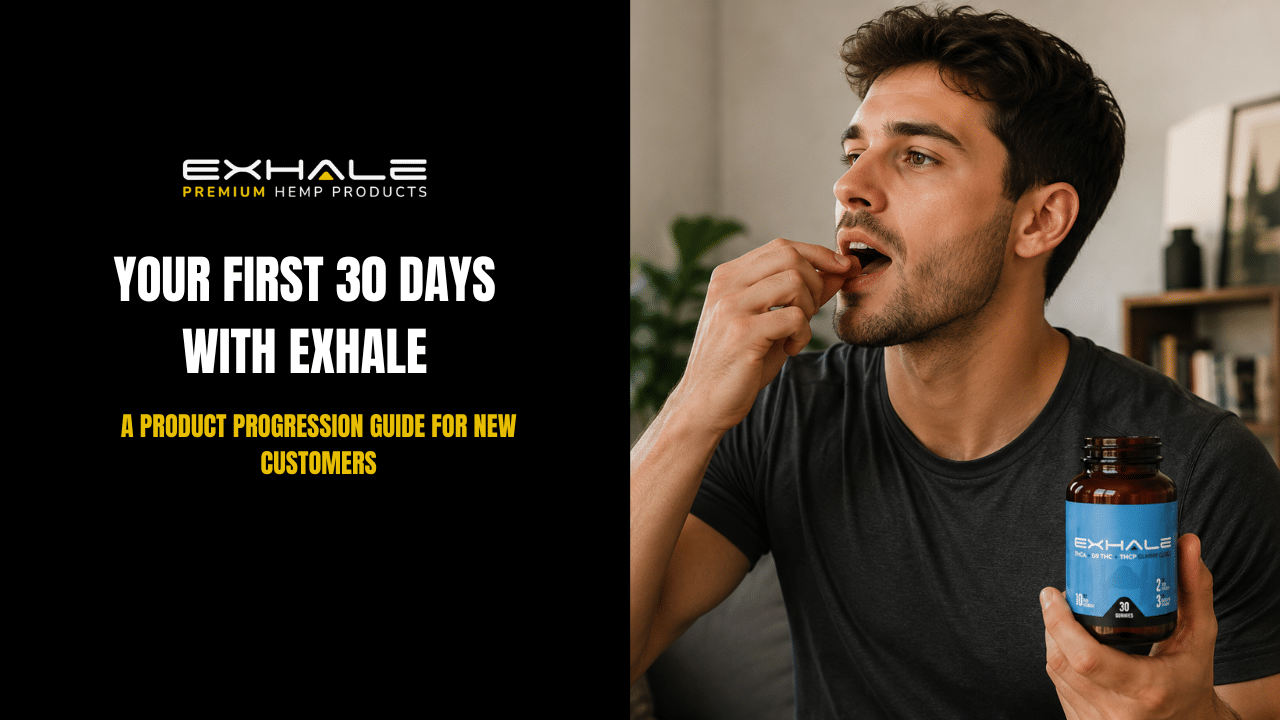
Most brands sell you a product and hope you figure it out. Here’s a jar of gummies. Good luck.
That approach works fine if you already know your tolerance, your preferred format, and what you’re trying to achieve. It doesn’t work at all if you’re new to hemp-derived THC, new to Exhale, or new to both. And judging by the questions customer support fields every day (“how much should I take?” “when should I take it?” “what do I try next?”), most new customers are navigating without a map.
This is the map. A 30-day guided progression from your first gummy to a personalized product routine, built around a simple principle: start with one product, learn how your body responds, then expand intentionally based on what you discover.
Before Day 1: What You Need
One starter product. If you’ve never used THC, begin with CBD+THC Gummy Cubes (2mg Delta-9 THC + 8mg CBD per piece, $44.95/30ct). The 4:1 CBD-to-THC ratio makes overconsumption anxiety nearly impossible and gives your endocannabinoid system the gentlest possible introduction.
If you have some cannabis experience (Delta-8 user, occasional smoker, or edible-curious), start with the Delta-9 Gummies at 15mg per piece. Take half (7.5mg) for your first session.
A notebook or phone note. Journaling sounds tedious until you realize it’s the single fastest way to find your dose. More on this below.
A clear evening. Your first session should happen when you have no obligations for 3 to 4 hours. At home. Comfortable. Nothing riding on how you feel.
Week 1: Discover Your Baseline (Days 1 to 7)
The goal: Find the dose where you notice a positive shift without feeling overwhelmed.
Day 1: Take one CBD+THC Cube (or half a D9 Gummy) at 6 PM. Set a timer for 90 minutes. Note the time, dose, and whether you ate recently.
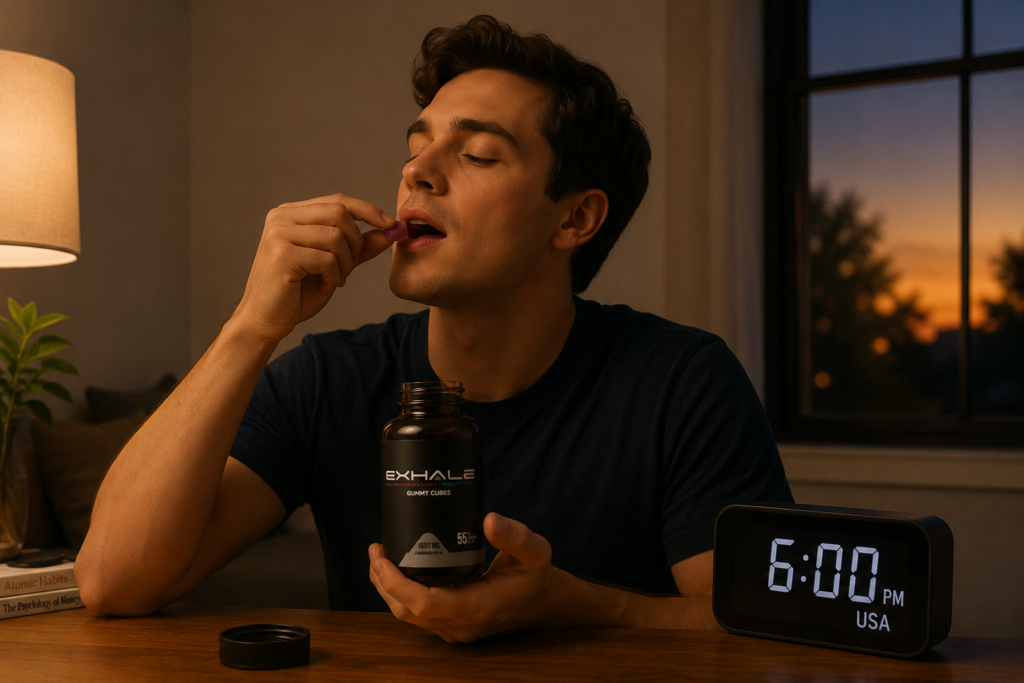
What to journal at the 90-minute mark: Do you feel different? If so, how? Rate your mood on a 1 to 10 scale. Rate your physical relaxation on a 1 to 10 scale. Note anything specific: better conversation flow, reduced shoulder tension, enhanced music appreciation, sleepiness, dry mouth.
Day 2: Same dose, same time. Journal again. Consistency matters because your body is establishing how it processes cannabinoids. The endocannabinoid system adapts over the first few exposures, and day-two effects often feel slightly different from day-one effects, usually smoother and more predictable.
Days 3 to 5: Continue the same dose. By day three, you should have a reliable sense of what this dose level does for you. If the effects feel right (gentle mood improvement, mild relaxation, functional calm), stay here for the full week. If you barely notice anything after three consistent days, increase by one cube or one-quarter gummy for days 4 and 5.
Days 6 to 7: Review your notes. You now have 5 to 7 data points. Look for patterns: consistent mood improvement? Better sleep on gummy nights? Reduced stress reactivity? Any unwanted effects (dry mouth, next-morning grogginess, mild anxiety)?
Week 1 outcomes: You now know your baseline dose. You know whether THC gummies produce the effect you were hoping for. You have a journal that tells you exactly what happened rather than relying on memory.
Week 2: Fine-Tune and Optimize (Days 8 to 14)
The goal: Dial in your ideal dose, timing, and context.
Timing experiments. Try your gummy at different times: morning (does it support focus or make you foggy?), afternoon (does it smooth the post-lunch slump or create drowsiness?), evening (optimal for relaxation, or do you prefer it earlier?). Most people discover that their ideal timing doesn’t match what they assumed. Journal each variation.
Context experiments. Same dose, different settings. Take your gummy before a social dinner one night and before a solo movie night another. Note how context changes the experience. THC responds to environment: stimulating settings tend to produce more stimulating effects, and quiet settings amplify relaxation.
Dose refinement. If Week 1 showed that one CBD+THC Cube (2mg) is too subtle, try 1.5 cubes (3mg THC + 12mg CBD). If half a D9 Gummy (7.5mg) was strong, try a third (5mg). The difference between “not enough” and “perfect” is often 1 to 3mg, and your journal data tells you exactly which direction to adjust.
Week 2 outcomes: You know your dose, your timing, and which contexts benefit most from THC. You have a personal protocol for one product, and it’s based on two weeks of actual data.
Week 3: Expand Your Format (Days 15 to 21)
The goal: Try a second product category to discover how different formats serve different needs.
This is where lifetime value separates a one-jar customer from a multi-product customer, and the reason for expanding isn’t marketing. It’s utility. Gummies are excellent for planned, scheduled use (evening relaxation, pre-social dosing, sleep). But they take 45 to 90 minutes to kick in and last 4 to 6 hours. Some situations call for faster onset, shorter duration, or localized effects that gummies can’t provide.
If your primary goal is relaxation or recreation: Try THCA flower or a THCA pre-roll. Smoked or vaped flower delivers effects in 2 to 5 minutes with a 1 to 3 hour duration, giving you faster control and shorter commitment. Start with a beginner-friendly strain in the 20% to 22% THCA range (Ice Cream Cookies, Grape Frosty, or Pineapple). One hit, wait 10 minutes.

If your primary goal is physical comfort or recovery: Try the CBD Relief Salve (1,000mg or 2,000mg full-spectrum CBD). Topical application delivers cannabinoids directly to sore muscles and joints without entering the bloodstream, meaning zero psychoactive effects, zero drug test implications, and zero interference with your gummy protocol. Apply after workouts, before bed, or whenever localized discomfort needs attention.
If your primary goal is sleep: Try the D9+CBN Sleep Gummies ($89.95/30ct). CBN is the most sedation-associated cannabinoid available. If your Week 1 and 2 gummies helped with sleep but didn’t fully solve it, the CBN addition targets the sleep gap specifically.
Week 3 journaling: Compare the new format to your established gummy protocol. Does flower provide something gummies don’t? Does the topical address the physical discomfort your gummies miss? Does the sleep formula outperform your standard gummy at bedtime? You’re building a multi-tool system, and each tool should earn its place by solving a specific problem the others can’t.
Week 4: Build Your Personal Stack (Days 22 to 30)
The goal: Establish a sustainable daily and weekly routine using 2 to 3 products that cover your primary needs.
By now you have three weeks of data across at least two product formats. Week 4 is where you assemble those discoveries into a routine you can maintain.
A sample stack for someone focused on stress and relaxation:
Morning: Nothing, or one CBD+THC Cube for background mood support on high-stress days. Evening: One D9 Gummy (or half, depending on your calibrated dose) at 6:30 PM for after-work decompression. Bed: CBD Relief Salve on shoulders and neck, plus half a Sleep Gummy if the day was physically demanding.
A sample stack for someone focused on fitness and recovery:
Pre-workout: Optional CBD gummy (25mg CBD, no THC) 45 minutes before training for calm focus. Post-workout: CBD Relief Salve on worked muscle groups immediately after. Evening: One D9 Gummy or THCA pre-roll for relaxation and sleep support.
A sample stack for someone focused on social wellness:
Weekday evenings: One CBD+THC Cube for gentle unwinding. Friday/Saturday social events: One CBD+THC Cube 60 minutes before the gathering. Occasional exploration: Kratom gummy for days when energy and focus are the goal instead of relaxation.

Week 4 journaling: Track the full routine, not just individual products. Does the combination produce better results than any single product alone? Are there redundancies (two products doing the same thing)? Adjust until the stack feels streamlined: every product earns its spot by addressing a need the others don’t.
The Journaling Framework (What to Track)
Your journal doesn’t need to be elaborate. Five data points per session are enough.
Date and time. Consistency in timing matters for identifying patterns.
Product and dose. Exactly what you took and how much. “One cube” is better than “some gummies.”
Stomach contents. Empty, light snack, or full meal. This affects onset timing and intensity.
Effects at 90 minutes. Mood (1 to 10), physical relaxation (1 to 10), any specific observations.
Next-morning assessment. Sleep quality, morning energy, any residual effects.
After 30 days, you’ll have a personalized cannabinoid database that no blog article, dosage chart, or customer review can replicate. It’s your body’s response to these specific products at these specific doses, and it’s the most valuable tool you’ll build in this entire process.
Understanding Tolerance Over Your First Month
Your body adapts to regular cannabinoid intake. This is normal and expected.
At the 2mg CBD+THC Cube level, tolerance develops slowly. Most users can maintain effectiveness at this dose for 4 to 6 weeks before noticing diminished effects.
At the 15mg D9 Gummy level, tolerance develops faster, typically within 2 to 3 weeks of daily use. You may notice that your Week 3 experience at 15mg feels less pronounced than your Week 1 experience.
The fix is simple: take a 48-hour break every 3 to 4 weeks. CB1 receptor density begins recovering within 48 hours of abstinence. Your first dose back will feel noticeably fresher. Build this break into your routine rather than waiting until products “stop working.”
Product rotation also helps. Using CBD+THC Cubes on weekdays and D9 Gummies on weekends, or alternating gummies with flower, exposes your receptors to different cannabinoid profiles rather than the same compound daily. This slows the adaptation process.
Setting Up Subscribe and Save (The Practical Step)
If your 30-day experiment confirms that cannabinoid products are part of your routine, running out mid-protocol disrupts the consistency that makes the routine work.
The EX Club rewards program and Subscribe-and-Save option deliver your chosen products on a recurring schedule at a discounted rate. Set the delivery frequency to match your actual consumption (not how fast the brand wants you to reorder). If a 30-count jar lasts 5 weeks with your calibrated dose, set a 5-week delivery cycle, not 4.
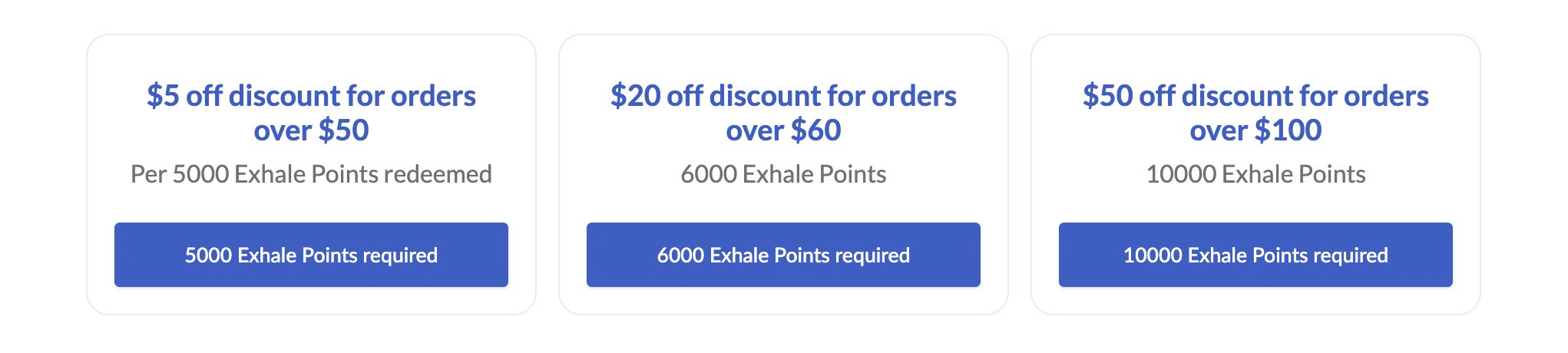
Orders over $80 ship free. Two products (a gummy jar plus a salve, for example) typically clear that threshold. The subscription removes the friction of remembering to reorder, which is the number one reason consistent routines break down.
What to Expect: Realistic Outcomes by Week
| Week | What Most New Customers Experience |
|---|---|
| Week 1 | Initial effects are novel and noticeable. Sleep often improves first. Mood effects are subtle. |
| Week 2 | Effects become more predictable as the ECS adapts. Optimal timing becomes clear. |
| Week 3 | Adding a second format reveals new use cases. The “stack” concept starts making sense. |
| Week 4 | The routine feels natural rather than experimental. Products have earned specific roles. |
| Month 2+ | Tolerance management becomes relevant. Periodic breaks and rotation keep things effective. |
Bottom Line
Your first 30 days with Exhale should feel like an experiment, not a commitment. One product, one dose, one week of data. Then refine. Then expand. Then build a stack that covers your actual needs rather than a marketing department’s idea of what you should want.
The customers who get the most value from Exhale aren’t the ones who buy the most products on day one. They’re the ones who start with one, learn what it does, and add the next one only when the data says they should.
Start the journal. Take the first gummy. And let 30 days of your own body’s feedback build the routine that no article can prescribe.
Disclaimer: THC products produce psychoactive effects and appear on drug tests. Not evaluated by the FDA. Effects described reflect common user reports, not guaranteed outcomes. Legal under the 2018 Farm Bill when hemp-derived. State laws vary. Start low, go slow. Consult a healthcare professional before use, especially if taking prescription medications.