
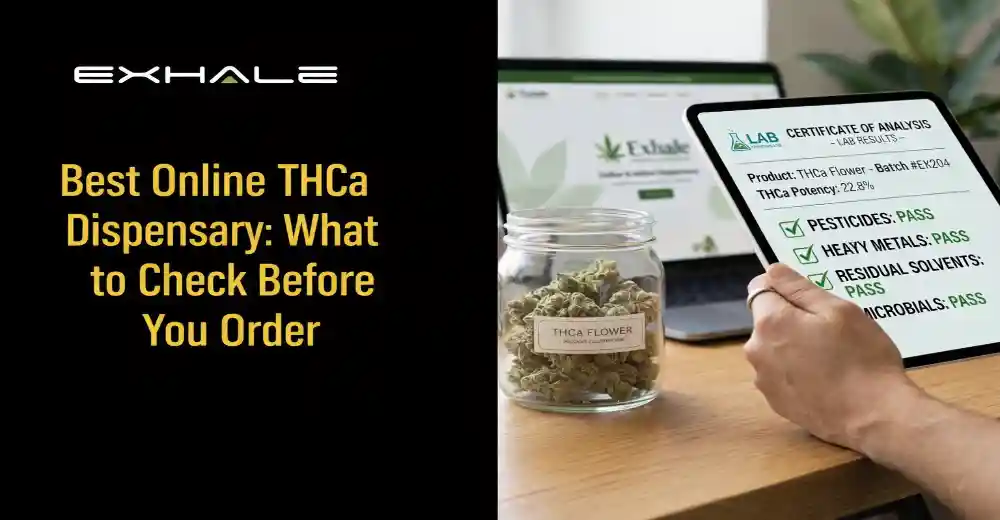
Typing “best online THCa dispensary” into a search bar and actually knowing what to do with the results are two very different skills. The market has exploded, the labels are confusing, and plenty of vendors are counting on you not asking the right questions. This guide covers exactly what separates reliable THCA sellers from risky ones, how to decode a Certificate of Analysis, and what to check before you hand over your payment details.
The Cannabinoid Honesty Scorecard
| Benefit Claim | Evidence Level | Source |
|---|---|---|
| THCA has anti-inflammatory properties | Emerging Research | Nallathambi et al., 2017, Journal of Neuroimmunology |
| THCA converts to Delta-9 THC when heated | Strong Evidence | Dussy et al., 2005, Forensic Science International |
| THCA produces psychoactive effects in raw, unheated form | Anecdotal | No peer-reviewed CB1 binding study confirms this for unheated THCA |
| THCA may have neuroprotective potential | Emerging Research | Moldzio et al., 2012, Phytomedicine |
| Third-party COA testing ensures product safety | Strong Evidence | FDA guidance on hemp product testing and labeling |
How Does THCA Work Before and After You Apply Heat?

THCA stands for tetrahydrocannabinolic acid, the raw acidic form of THC that exists naturally in the cannabis plant before any heat is applied. In this acid form, THCA does not bind meaningfully to CB1 receptors in the brain or central nervous system. That is why consuming raw THCA flower does not produce the psychoactive effect associated with Delta-9 THC (Dussy et al., 2005, Forensic Science International).
Heat changes everything. When you smoke, vape, or bake THCA, a chemical reaction called decarboxylation removes the carboxyl group from the molecule and converts it to Delta-9 THC. That converted compound then binds to CB1 receptors in the brain and produces the effects most people associate with cannabis. The conversion rate is not always 100% and depends on temperature, duration, and product format.
Beyond the classic CB1 and CB2 endocannabinoid pathways, research from Moldzio et al. (2012) published in Phytomedicine suggests that raw THCA may interact with TRPA1 channels and PPARgamma receptors. These pathways are linked to inflammation and neuroprotection in preclinical models. The data is preliminary and derived from cell cultures rather than human trials, but it offers a plausible mechanism for some of the effects users report from unconverted THCA.
What Makes the Best Online THCa Dispensary Actually Stand Out?
The best online THCa dispensary is not the one with the flashiest branding or the most five-star reviews from accounts created last Tuesday. It is the one that lets you verify product quality before you buy anything. Here is how to spot it.
Third-party lab testing is the foundation. Every reputable vendor publishes a Certificate of Analysis from an independent, accredited laboratory for each batch of product. The COA should confirm cannabinoid potency, test for pesticides, heavy metals, residual solvents, and microbials, and include a batch number that matches what you are ordering. If a site does not show a COA, or the COA is more than a year old, move on.
Sourcing transparency is the second signal. Trustworthy sellers tell you where their hemp was grown, whether it was cultivated indoors or outdoors, and how the product was processed. Under the 2018 Farm Bill (7 U.S.C. Section 5940), compliant hemp must come from a licensed U.S. grower. A vendor that cannot or will not tell you where the plant came from is not a vendor worth trusting.
Customer service and return policies round out the picture. Any dispensary confident in its products makes it easy to contact a real person with questions and offers clear policies if something arrives damaged or mislabeled. If the site makes those things hard to find, that tells you something.
How to Read a COA Before You Order THCa Flower Online

A COA is your most powerful tool as a buyer, but only if you know what the numbers mean. Start with the THCA percentage. Quality THCA flower generally falls between 18% and 28% THCA by weight. Anything below 15% is on the lower end for what is currently marketed as premium THCA flower. The COA is the only reliable way to verify this number because labels alone are not regulated with the same scrutiny as the underlying test data.
Check the Delta-9 THC percentage separately and carefully. Federal law requires hemp to contain 0.3% or less Delta-9 THC on a dry weight basis. If the COA shows Delta-9 above that level, the product is legally classified as marijuana under federal law, regardless of what the packaging says. That is not a minor technicality. It affects shipping legality, possession in certain states, and what you are actually consuming.
Contaminant panels matter as much as cannabinoid percentages. A COA that only lists cannabinoids without a pesticide screen, heavy metal panel, residual solvent test, and microbial test is incomplete. Reputable vendors run and publish all four panels. If panels are missing, ask the vendor directly before placing an order. A company that responds well to that question is worth buying from. A company that deflects it is not.
The Onset Timeline
Format: THCA Flower, Smoked or Vaped
Individual variation is real and significant. Body weight, metabolism, prior cannabinoid tolerance, and the specific product all affect how these windows play out for you.
| Time After Use | What Many Users Report |
|---|---|
| T+0 to T+5 min | First signs of shift: warmth, a change in mood or sensory perception |
| T+10 to T+15 min | Effects become clearly noticeable; relaxation or mild euphoria building |
| T+30 min | Peak effects for most users under typical conditions |
| T+1 to T+2 hr | Effects plateau and begin tapering gradually |
| T+2 to T+4 hr | Most effects resolve; residual calm in some users |
Who Should NOT Use THCA Products
This section is a YMYL safety requirement. Read it.
- Pregnant or breastfeeding individuals: The NIH and the American College of Obstetricians and Gynecologists advise against any cannabis use during pregnancy. Delta-9 THC, which THCA converts to, crosses the placental barrier and appears in breast milk (ACOG Committee Opinion, Number 722, 2017).
- People taking CYP3A4-metabolized medications: THC inhibits cytochrome P450 enzymes including CYP3A4 and CYP2C9. This can alter blood levels of warfarin, certain statins, benzodiazepines, and other prescription drugs. Speak with a pharmacist before using any cannabinoid product if you take medication regularly (Zhu et al., 2006, Drug Metabolism and Disposition).
- People with a personal or family history of psychosis or schizophrenia: Multiple studies link high-potency THC use with elevated risk of psychotic episodes in predisposed individuals. Di Forti et al. (2019, The Lancet Psychiatry) found daily use of high-potency cannabis significantly increased first-episode psychosis rates.
- Anyone under age 21: Developing brains are more sensitive to THC’s effects. Legitimate dispensaries enforce age verification at checkout.
- Anyone subject to workplace or legal drug testing: THCA converts to Delta-9 THC through heat and metabolism. Standard urine drug screens detect THC metabolites. A “hemp” label does not protect you from a positive result.
What We Don’t Know Yet
- No long-term human trials (beyond six months) exist examining THCA-specific effects at typical consumer dose ranges as of 2024. Most published data comes from preclinical animal or cell models, not human subjects.
- THCA’s direct receptor pharmacology in humans remains poorly characterized. The Moldzio 2012 study examining non-CB1 activity used cell cultures. No large-scale human pharmacokinetic study for unconverted THCA had been published as of the time of writing.
- Bioavailability data for raw, unconverted THCA consumed orally or inhaled is essentially absent from peer-reviewed literature. Researchers do not yet know how much THCA absorbs intact versus converting during digestion or inhalation before reaching target tissues.
- No regulatory body has established standardized dosing guidelines for THCA. Unlike CBD, which has an FDA-approved pharmaceutical form with documented dosing (Epidiolex), THCA has no equivalent benchmark. Comparing dose-effect claims across products is not currently reliable.
State-by-State Legal Snapshot
Last verified: March 2026. Cannabis and hemp laws change frequently. Always confirm current status through your state legislature’s official website before ordering.
| State | THCA Flower Legal Status | Notes |
|---|---|---|
| Texas | Legal (hemp-compliant) | SB 3 proposed restrictions; verify current status at capitol.texas.gov |
| Florida | Legal (hemp-compliant) | Age verification required at point of sale |
| California | Legal (hemp-compliant) | Additional state labeling requirements apply |
| Colorado | Restricted | State law extends beyond federal definitions on hemp derivatives |
| Oregon | Legal (hemp-compliant) | OLCC oversight applies to some inhalable hemp products |
| Arkansas | Restricted | Act 629 (2023) prohibits intoxicating hemp-derived products |
| Indiana | Legal (hemp-compliant) | No additional THCA-specific restrictions as of March 2026 |
| New York | Legal (hemp-compliant) | OCM licensing required for retail sellers |
| Minnesota | Legal (hemp-compliant) | Regulated under HF 100; THC product rules apply |
| Virginia | Legal (hemp-compliant) | Retail hemp regulations actively enforced |
Exhale Lab Note
Lab Note: Our THCA flower is cultivated using small-batch indoor growing methods because we believe that controlled environments produce more consistent cannabinoid and terpene profiles than field-grown alternatives. Every batch goes through full-panel third-party testing at an ISO-accredited laboratory, and we publish the complete COA, including pesticide, heavy metal, residual solvent, and microbial results on every product page. If you want to check our numbers, they are right there.
FAQ
Is it legal to buy THCA flower online?
In most U.S. states, yes. THCA flower containing 0.3% or less Delta-9 THC on a dry weight basis meets the federal definition of hemp under the 2018 Farm Bill. A handful of states have enacted restrictions on intoxicating hemp products. Always verify your specific state’s current law through the official state legislature website before placing an order.
Will THCA show up on a drug test?
Almost certainly. When THCA is heated or metabolized, it converts to Delta-9 THC, which is what standard urine drug tests are designed to detect. Even consuming THCA in raw form can result in some metabolic conversion. Do not use THCA products if you face employment or legal drug screening requirements.
What is the difference between THCA and Delta-9 THC?
THCA is the raw acidic precursor to THC found in the living hemp plant. It does not bind strongly to CB1 receptors in its unheated form, which means it produces little to no psychoactive effect on its own. Applying heat through smoking or vaping converts THCA into Delta-9 THC through decarboxylation, and that converted compound is what produces the intoxicating effects.
How much THCA should quality flower have?
Most premium THCA flower tests between 18% and 28% THCA on a COA. Products below 15% exist but are generally considered lower potency in the current market. The COA from a third-party lab is the only reliable way to verify potency. Label claims without a supporting COA are not sufficient verification.
How do I tell if an online THCa dispensary is trustworthy?
Look for three things: a publicly available, batch-specific COA from a named accredited laboratory; clear sourcing information telling you where and how the hemp was grown; and transparent policies on contact, shipping, and returns. Reputable sellers make all three easy to find. Those with something to hide make it difficult.
Can I travel by plane with THCA flower?
This is legally complicated. TSA focuses on federal law, and hemp-compliant THCA falls under the federal threshold on paper. However, TSA agents are not obligated to test or verify compliance, and destination state laws vary significantly. Traveling with THCA flower carries real practical and legal risks that vary by route and state. Consult a local attorney before attempting to travel with any cannabis product.
Buying from the best online THCa dispensary is less about finding the most popular name and more about knowing what proof to ask for. A complete COA from an independent lab, transparent hemp sourcing, and verifiable Delta-9 compliance are the baseline. Everything else is marketing. Once you know what those numbers mean, the field narrows quickly, and the right choice becomes much easier to spot. If you want to see what fully tested, small-batch THCA flower actually looks like in practice, Exhale’s flower collection is a straightforward place to start.