
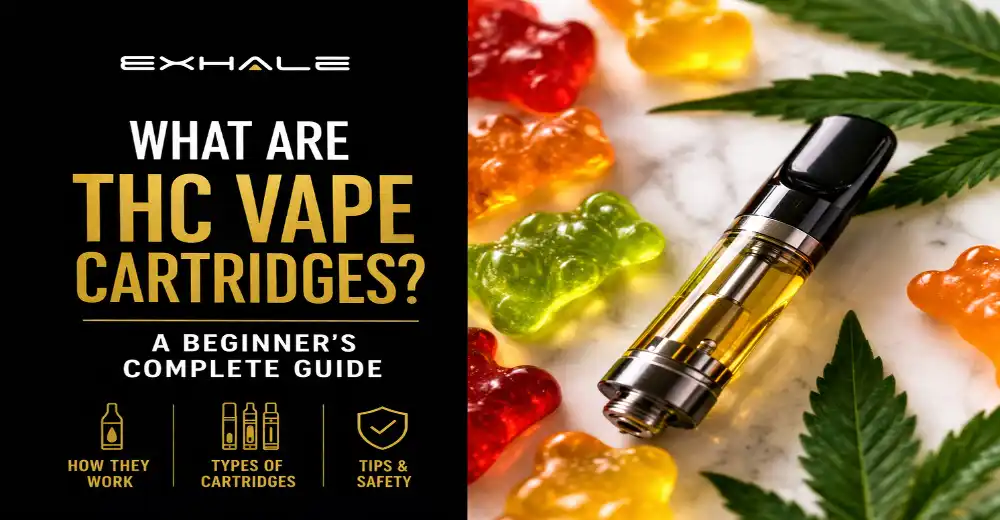
If you have walked into a dispensary or browsed a hemp site lately, you have probably noticed THC vape cartridges everywhere. They are compact, discreet, and faster to use than almost any other format. But what exactly are they, how do they work, and how do you pick the right setup? This guide covers everything a first-timer needs to know, from cartridge types to device compatibility, so you can make a confident, informed choice.
Before you choose a cartridge, you will need a compatible device to run it. You can explore Exhale Wellness THC vaporizers designed for smooth, controlled sessions before you commit to a cart.
Cannabinoid Honesty Scorecard
| Benefit Claim | Evidence Level | Source |
|---|---|---|
| THC produces psychoactive effects via CB1 activation | Strong Evidence | Pertwee RG, Br J Pharmacol, 2008 (PMID 17828291) |
| Vaping delivers faster onset than edibles or capsules | Strong Evidence | Huestis MA, Chem Biodivers, 2007 (PMID 17589870) |
| THC may reduce nausea in certain clinical contexts | Emerging Research | NIH NCI, Cannabis and Cannabinoids PDQ, 2023 |
| THC improves long-term sleep quality | Anecdotal | No peer-reviewed RCT over 6 months exists as of 2024 |
How Does a THC Cartridge Work in Your Body?
A THC cartridge delivers delta-9-tetrahydrocannabinol through heated vapor, which enters your lungs and is absorbed into the bloodstream within minutes. From there, THC travels to the brain and binds primarily to CB1 receptors, the receptors that govern mood, memory, pain perception, and appetite. This is not a vague wellness interaction. It is a specific, documented pharmacological event.
THC acts as a partial agonist at CB1 receptors, meaning it activates those receptors without pushing them to full capacity. This is unlike synthetic cannabinoids, which trigger far more intense and unpredictable effects. A 2008 study by Pertwee, published in the British Journal of Pharmacology, confirmed this partial agonist behavior and explained why natural THC has a natural ceiling on psychoactive intensity. CB2 receptors, found mostly in immune tissue, play a smaller role with THC compared to CBD.
Inhalation is the fastest cannabinoid delivery method available. A 2007 study by Huestis in Chemistry and Biodiversity found that peak THC plasma concentrations appear within 3 to 10 minutes of inhalation. That speed is both the appeal of the cannabis vape format and the reason new users should start with one or two puffs and wait.
Onset Timeline: THC Vape Pen
| Time After Inhaling | What You Might Notice |
|---|---|
| T+5 to 10 min | First effects begin, a mild shift in perception |
| T+15 to 30 min | Peak effects for most users |
| T+1 hr | Effects plateau or begin to taper |
| T+2 hrs | Noticeable decline in intensity |
| T+3 to 4 hrs | Most effects resolved for average users |
Note: Individual variation is significant. Body weight, tolerance, metabolism, and the specific THC concentration in your cartridge all influence this timeline.
What Types of THC Cartridges Can You Buy?
Not all marijuana cartridges are built the same, and picking the wrong format is one of the most common beginner mistakes. The three main types are 510-thread cartridges, pod systems, and all-in-one (AIO) devices. Each suits a different lifestyle and experience level.
510-thread cartridges are the industry standard. They screw onto a battery with a universal 510-thread connection, compatible with most vape batteries on the market. These are the most widely available, easiest to swap out, and come in the broadest range of strains and formulations. Most 510-thread cartridges require a compatible vape battery, so if you need a reliable device to pair with, you can browse THC vaporizers compatible with 510 carts directly from Exhale.
Pod systems use proprietary cartridges that snap into a specific brand’s device. They tend to be more beginner-friendly because the draw resistance comes pre-calibrated. The downside is that you are locked into one brand’s ecosystem with limited flexibility.
All-in-one (AIO) devices combine the battery and cartridge into a single disposable unit. Nothing to charge, thread, or swap. They are convenient for travel but generate more waste and cost more per milligram of THC than refillable setups.
How to Pick the Right Cannabis Vape for You
Pairing the right cartridge with the right device makes a bigger difference than most beginners expect. If you are starting out, combining a beginner-friendly cartridge with a reliable, adjustable device is the move. You can explore the THC vaporizers collection from Exhale Wellness, built with adjustable voltage and smooth airflow specifically for new users.
Go with a variable-voltage battery and keep your temperature around 2.4V to start. Lower voltage preserves terpenes, gives a smoother draw, and reduces harshness. Higher voltage produces more vapor but burns through aromatic compounds faster.
THC Cartridges vs THC Vaporizers: What Is the Difference?
A lot of beginners use “cartridge” and “vaporizer” interchangeably, but they are two separate things. Getting this straight saves you from buying incompatible gear.
A THC cartridge is the oil container. It holds the distillate, live resin, or full-spectrum oil and does nothing on its own. Think of it as the ink cartridge in a printer.
A THC vaporizer is the device. It is the battery, heating element, and airflow system that actually powers the experience. You need both to get anywhere. The quality of your vaporizer directly shapes how your cartridge performs, which is something many first-time buyers overlook completely.
If you want the full picture before you buy, it is worth spending a few minutes browsing THC vape devices to understand the hardware side before committing to a cart.
CTA BLOCK
Looking for a complete vape setup? Explore Exhale’s premium THC vaporizers designed for performance, safety, and terpene preservation.
Why Your Vaporizer Matters More Than Your Cartridge
Most beginners obsess over which oil to buy and treat the device as an afterthought. That is a mistake. The vaporizer controls three things that determine your entire experience: temperature, coil quality, and airflow.
Temperature is the biggest variable. THC and terpenes vaporize at different temperatures, and most entry-level fixed-voltage batteries run too hot. Overheating degrades terpenes before they reach you, produces harsher vapor, and can convert THC into CBN faster than intended. A vape battery with adjustable voltage (and ideally a preheat function) solves this. Using a high-quality vaporizer also reduces the risk of burnt hits and overheating, which is a common complaint with cheap hardware. You can view lab-compatible THC vaporizers from Exhalewell, built with these considerations in mind.
Coil quality affects both flavor and longevity. Ceramic coils preserve terpene profiles better than metal coils at lower temperatures. They also tend to last longer and produce cleaner vapor. Cheap coils introduce a metallic taste and degrade faster.
Airflow determines draw resistance. A restrictive draw (tight airflow) mimics a cigarette pull. An open draw produces larger clouds with less resistance. Neither is better by default; it depends entirely on your preference.
Best THC Vaporizer Setup for Beginners

If you want a no-regrets starting setup, here is the combination most experienced users recommend for beginners using a THC vape pen for the first time.
Go with a 510-thread cartridge in a strain you find appealing, whether that means indica-leaning for relaxation or a more balanced hybrid. Pair it with a variable-voltage battery with at least three heat settings. Start at the lowest setting and work upward over multiple sessions. This approach lets you dial in your experience rather than getting blindsided by an uncomfortably strong hit on your first try. For hardware built with this beginner-friendly approach, the Exhale Wellness THC vape hardware range is worth a look before you decide.
Is Your State Legal for THC Vape Cartridges?
THC legality in the US depends almost entirely on where you live and what type of THC you are buying. Delta-9 THC from marijuana remains federally controlled under the Controlled Substances Act. Hemp-derived delta-9 THC products containing less than 0.3% THC by dry weight are federally legal under the 2018 Farm Bill. State laws vary widely, so always verify with your official state cannabis authority before purchasing.
State-by-State Legal Snapshot (Verified March 2025)
| State | Recreational | Medical | Hemp Delta-9 (under 0.3%) | Notes |
|---|---|---|---|---|
| California | Legal | Legal | Legal | DCC regulates |
| Texas | Illegal | Limited | Legal | SB 3 pending 2025 |
| Florida | Illegal | Legal | Legal | Amendment 3 failed Nov 2024 |
| Colorado | Legal | Legal | Legal | Fully regulated |
| New York | Legal | Legal | Legal | OCM oversees |
| Georgia | Illegal | Limited | Legal | HB 324 applies |
| Idaho | Illegal | Illegal | Restricted | Strict hemp laws |
| Illinois | Legal | Legal | Legal | IDFPR regulates |
| Nevada | Legal | Legal | Legal | CCB oversees |
| Tennessee | Illegal | Illegal | Legal with limits | HB 1483 active |
Last verified: March 2026. Laws change frequently. Always confirm with your state legislature’s official site.
Terpene-Effect Cross-Reference (ExhaleWell COA Data)
| Terpene | Typical % in Exhale Carts | Associated Effects | Research Basis |
|---|---|---|---|
| Myrcene | 0.8 to 1.2% | Relaxing, sedative-adjacent | Russo EB, Br J Pharmacol, 2011 |
| Limonene | 0.4 to 0.7% | Mood elevation, stress reduction | Guimaraes et al., Chem Biol Interact, 2012 |
| Caryophyllene | 0.5 to 0.9% | Anti-inflammatory potential | Bento et al., Eur J Pharmacol, 2011 |
| Pinene | 0.2 to 0.5% | Alertness, memory support | Seo et al., J Agric Food Chem, 2015 |
Percentages are representative ranges drawn from available COA data. Verify your specific batch at exhalewellness.com.
Exhale Lab Note: Our THC vape cartridges use a solvent-free CO2 extraction process because it preserves the full terpene profile without introducing residual chemicals. We send every batch to accredited third-party labs and publish the COAs openly, so you always know exactly what is in your cart before you inhale it. No guessing, no surprises.
Who Should Not Use THC Cartridges?
THC is not appropriate for everyone. Review this list carefully before you buy.
- Pregnant or breastfeeding individuals: The CDC and the American College of Obstetricians and Gynecologists advise against any cannabis use during pregnancy or lactation due to documented risks to fetal brain development.
- People taking blood thinners (warfarin): THC may inhibit CYP2C9 enzymes and increase bleeding risk. A 2017 case report in Pharmacotherapy documented elevated INR in a warfarin patient following cannabis use.
- People using sedatives or benzodiazepines: Additive CNS depression is a documented concern. Consult a physician before combining any cannabinoid with prescription sedatives.
- Anyone with a history of psychosis or schizophrenia: THC at higher doses may trigger or worsen psychotic episodes, per a 2019 review in The Lancet Psychiatry.
- Anyone under 21: THC has well-documented negative effects on the developing adolescent brain, per NIDA research updated in 2023.
- People with severe cardiovascular conditions: THC temporarily elevates heart rate. Those with arrhythmia or a recent cardiac event should get clearance from a cardiologist first.
Sources: CDC (2022), Pharmacotherapy (2017), The Lancet Psychiatry (2019), NIDA (2023).
What We Still Do Not Know About THC Vaping
The science on cannabinoids has advanced meaningfully, but real research gaps remain.
- No long-term human trials (over 12 months) have examined the pulmonary effects of hemp-derived THC vaping specifically, as of 2024. Most existing data comes from marijuana cigarette studies, which are not directly comparable to vapor delivery.
- The long-term impact of inhaling heated terpenes, particularly at temperatures above 200 degrees Celsius, has not been studied in controlled human trials.
- No standardized therapeutic dosing protocol exists for inhaled THC for any condition. Every dosage recommendation you read online is an informal estimate, not clinical guidance.
- The interaction between synthetic terpene additives, common in lower-quality carts, and the endocannabinoid system remains largely unexamined in peer-reviewed human research as of 2024.
Frequently Asked Questions
What is a THC cartridge?
A THC cartridge is a pre-filled chamber containing THC oil designed to attach to a battery-powered vape pen. When heated, the oil vaporizes, and you inhale the vapor. They come in distillate, live resin, and full-spectrum formulations, each with a different cannabinoid and terpene profile.
What is the difference between a THC cartridge and a THC vaporizer?
A cartridge is the oil container. A vaporizer is the device that heats it. You need both to use a THC vape pen setup. The quality of your vaporizer (temperature control, coil type, airflow) shapes how every cartridge performs, which is why hardware choice matters as much as oil quality.
How long does a THC cartridge last?
A standard 1g cartridge delivers roughly 150 to 300 puffs, depending on draw length and temperature. For a light user taking one to two puffs per session, that can last several weeks. A heavy daily user may finish a gram in under a week.
Can a THC cartridge make you fail a drug test?
Yes. THC metabolizes into THC-COOH, the compound that standard urine drug tests detect. Even legal hemp-derived THC products can trigger a positive result. Detection windows range from 3 days to over 30 days, depending on frequency of use, dose, and individual metabolism.
Are THC cartridges safe to use?
Reputable, lab-tested cartridges from compliant brands carry far lower risk than unregulated black-market products. The 2019 EVALI outbreak linked to vitamin E acetate came almost entirely from untested carts. Always check a brand’s published COA before purchasing any cannabis vape product.
How do I store a THC cartridge?
Store upright, away from direct sunlight, heat, and humidity. Extreme heat thins the oil and causes leaks. Extreme cold thickens it and clogs the mouthpiece. A dark drawer at room temperature works well for most formulations and preserves terpene integrity over time.
THC cartridges have made cannabis more accessible than at any previous point, and the format genuinely delivers on its promise when you buy right. Knowing your cartridge type, understanding your device, and being honest about whether THC suits your health situation are what separates a great first session from a regrettable one. If you are ready to explore, the Exhale Wellness THC vaporizers catalog is a strong starting point, with verified COAs, adjustable hardware, and formulations built for people who care about what goes into their bodies.
Sources cited: Pertwee RG, Br J Pharmacol (2008) | Huestis MA, Chem Biodivers (2007) | NIH NCI Cannabis PDQ (2023) | Russo EB, Br J Pharmacol (2011) | The Lancet Psychiatry (2019) | NIDA (2023) | CDC (2022) | Pharmacotherapy (2017)